


BOOK REVIEW
The Sparrow
Mary Doria Russell
New York: Ballantine, 1996

The title to The Sparrow comes from the verse in the Bible in which Jesus says that even no sparrow can fall without God taking notice. Jesus’ point is that, if God notices even the lowly sparrow, then he surely must notice each of us. This novel raises the question of whether God does notice us, that is, does God even exist; and if he exists, does he care, or if he does care when we die, especially if we die horribly, is he a good God. It’s a story in which it is impossible to separate the theological aspects of the story from the overall theme, even for an atheist such as me.
The central figure in the story is Father Emilio Sandoz, a natural linguist and shepherd to the dispossessed. The supporting characters are so central to the plot that it is almost an ensemble piece. We have Sofia Mendes, a Jewish woman, indentured into using her mind to work off her debt, and who Fr. Sandoz and Jimmy Quinn both fall in love with. George and Anna Edwards are two fun-loving mid-sixty year olds, he an engineer and she a physician. They are Fr. Sandoz’s closest friends. Jimmy Quinn is an astronomer. D.W. Yarborough and Marc Robichaux are both Jesuits, one an official of the church and the other a naturalist. Alan Pace is a Jesuit musicologist. After Jimmy Quinn discovers a radio signal filled with other-worldly music coming from a planet orbiting the three-star Alpha Centauri system, the group, at the insistence of Emilio Sandoz, convinces the Jesuit order to send them on an expedition to Rakhat, the planet from which music originated.
Fr. Emilio Sandoz views the mission to Rakhat as the affirmation of the existence of God, and for much of the time on the alien planet, their time is idyllic, except for the early death of Pace, the musicologist. They discover there are two sentient bipedal species on the planet, one that is subservient to the other. Things become more complicated and I won’t give away the plot, except to say that we learn early in the novel, that Sandoz is the only survivor of the group and he is shattered and shamed when he is brought back to Earth accused of becoming a prostitute and killing an innocent child on Rakhat. He also terribly injured, physically, and as the novel progresses, his questioners from the Jesuit order slowly get the story from him about what happened on the planet.
The deep psychological trauma and loss of faith experienced by Fr. Sandoz dominates the scenes back on Earth after Sandoz’s rescue. How that will affect the Jesuit order and the belief of its Father General, Vincent Guiliani is an implicit issue as Fr. Sandoz gradually reveals what happened on Rakhat. I found these issues as important to the plot as the experiences of the crew after landing on the planet. The characterization of the two species on Rakhat is challenging in terms of judging their morality. I was reminded of how difficult it would be to impose our cultural values on another species from another world, and how challenging to fit what we find into our way of making sense of the universe and even our own existence. The closest I could come was to imagine that a space-traveling race of Octopii (as depicted by Adrian Tchaikowsky), visited Earth and found us feasting on seafood, including octopus. That isn’t what happened to the humans in The Sparrow, but what they encountered was equally mind-boggling, and perspective changing. The author, Mary Doria Russell goes straight to such core issues, while making the story as exciting an adventure as any well-written thriller.

I’ve just begun the sequel to The Sparrow, which is called Children of God. I’m only a couple of chapters into it, but the author continues to have Fr. Sandoz wrestle with the same questions of faith. I find it fascinating and provocative. If I thought I had a soul, I would say it caused some soul-searching, but I don’t, so I will only say it stretches my mind. I’m sure reading The Sparrow will stretch yours too.
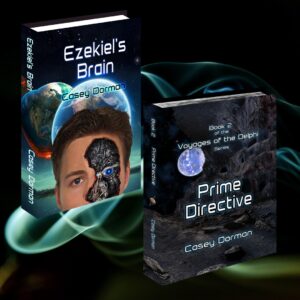
Interested in scif-fi about AIs solving moral dilemmas in a future that has them exploring our galaxy? Read Casey Dorman’s Voyages of the Delphi novels: Ezekiel’s Brain and Prime Directive. Available on Amazon. Click Here!
Subscribe to Casey Dorman’s Newsletter. Click HERE