


“There are moments, rare and powerful, in which a writer, long vanished from the face of the earth, seems to stand in your presence and speak to you directly, as if he bore a message meant for you above all others.”
Stephen Greenblatt, The Swerve: How the World Became Modern
Yesterday, I ordered a hardbound copy of The Complete Works of Michel de Montaigne. I was familiar with snippets of some of Montaigne’s most famous essays, written nearly 500 years ago, but I have not read any of them in its entirety. My interest had been piqued by my reading Stephen Greenblatt’s book, The Swerve, about the discovery of a copy of Lucretius’ first century BCE poem describing the philosophy of the Greek, Epicurus, and the influence of the ideas in the poem on our modern world. I have been a fan of Epicurus and Lucretius’ poem, which is the most complete account of the Greek’s philosophy available, for many years. I had included Epicurus as a character in my novel, Ezekiel’s Brain, and the protagonist of a new novel I am working on is a fictional professor of literature who is teaching Lucretius’ poem and its influence on literature to his students. Montaigne, perhaps more than any other Renaissance figure, was directly affected by reading Lucretius. In turn, Montaigne, often thought of as the “father of the essay,” influenced intellectuals from Descartes and Hobbes, to Shakespeare, to Jefferson, to the existentialist thinkers, Sartre, Camus, and de Beauvoir. I wanted to hear what Montaigne had to say directly from his own pen.

Oftentimes, when humans write—either essays, nonfiction books, or fiction and poems—they do so as a means to express their thoughts and feelings about their lives, their culture, their views on human relationships, or human struggles, all based on their experiences. This is not always so, since some very good fiction and poetry is written almost purely from the desire to express entertaining or pleasing words or stories, or even just to sell copies and gain enough popularity to make a living. I’m not sure how writers come up with the words and sentences they use, and I’m not even sure that the process is not at least analogous to how an AI, such as ChatGPT comes up with what it says. Most accounts that make the human process seem more profound, such as “getting in touch with one’s spirit,” or “speaking directly from the heart,” or “tapping into a deeper level of consciousness,” are metaphors expressing something we don’t understand in flowery words. At a neurological level, something akin to electrical activation of neural networks to trigger the neural equivalent of words and phrases, based on previous experiences reading, listening or speaking is what’s going on, and this isn’t much different than an AI. The brain and an AI are both physical systems that operate based on conduction of electrical charges.
What the AI does not possess is a life of experiences. More accurately, the AI’s experiences are strictly linguistic, although increasingly, visual, spatial, and perhaps in the future, tactile, experiences can be integrated with those based on language. The AI has not felt fear or sexual attraction, frustration or jealousy. It has not wondered how things work or why this happened to it rather than that. It has not formed friendships, had parents or children, felt hungry or tired, or been pessimistic or excited about its own life or its future. It has read about such things and can produce a close facsimile of the words used to express them, but it’s not experienced the real thing. When we read its descriptions of such things, we may be in awe of how well it can capture them in words, but we’re not in awe because it went through such experiences.
We can’t read what an AI says and then think to ourselves, “here’s another person who went through what I’ve gone through and feels just the way I do.” If we do think that to ourselves, we are seriously deluded.
I read a lot about how well AIs can mimic what humans say and write, even what we think when we think in words or numbers, perhaps even in pictures. Their proficiency at such things is lauded by some, despised by others, and denied by many. It’s easy to dismiss AI because it makes things up, makes mistakes, and echoes platitudes. It does these things often enough that other AIs, trained to look for such characteristics, can spot an AI product and alert a professor, for instance, that the student essay they were impressed with was composed by an AI. But, as Yale Review editor Meghan O’Rourke has said, “it’s “so much better than it was a year ago that I can’t imagine where it will be in five years.” We make a mistake by denying AI abilities based on what they can do today. Wait until tomorrow.
But they’re not human. If I’m hoping to experience one of those “moments, rare and powerful,” as Greenblatt describes it, where I make a connection to another human being and feel less alone, more understood, and in greater synchrony with other human beings, by reading what someone has written, I will not find it in AI generated writing. If I do, as I said, I am deluding myself.

I’ve imagined a world in which AIs are conscious beings. I’ve written about it in my Voyage of the Delphi series. Should a time ever come when science fiction comes true and an AI becomes conscious, then things will change. As one of the characters in my newest novel in the series, The Gaia Paradox, says, “In terms of the mathematical algorithms that support consciousness, there is no difference between an AI and a human being. To extinguish consciousness is to destroy the essence of a sentient life.” Such an AI would be alive, even if it was a machine. It would have experiences in the sense that it would not just record what it encountered and how it responded, but would try to put those experiences into a coherent, meaningful story it could tell itself. It wouldn’t be human, but we might. be interested in how it experienced its life. We’d have to think twice before we erased its hard drive.
But that’s well into the future, if it happens at all. For now, there is a basic difference in what AIs can write and what humans can write. That difference is simply that the human writing reflects the experiences, thoughts and feelings of a person. The AI writing does not. It’s why I prefer to read what other people write instead of what an AI writes.
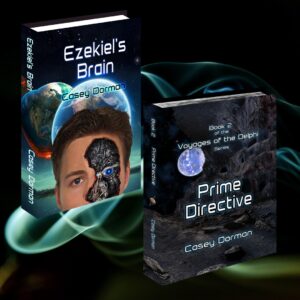
Interested in scif-fi about AIs solving moral dilemmas in a future that has them exploring our galaxy? Read Casey Dorman’s Voyages of the Delphi novels: Ezekiel’s Brain and Prime Directive. Available on Amazon. Click Here!
Subscribe to Casey Dorman’s Newsletter. Click HERE