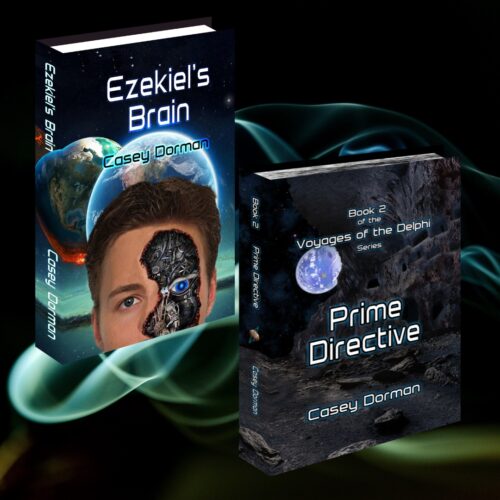


The third book in my science fiction series, The Voyages of the Delphi will be released from NewLInk Publishing soon. For those of you who haven’t read either Ezekiel’s Brain or Prime Directive, the two earlier novels, the series concerns the development of conscious, autonomous AIs who, after one of them kills off humanity, form a civilization based on the model of ancient Greece, and sends a team of AI androids to search for other life in the galaxy. It admittedly has a Star Trek flavor to it, but with a crew of androids instead of humans, Vulcans, or Klingons. Beginning in the second novel in the series, a human empath joins the crew. The central character is Ezekiel, an AI whose brain is an electronic copy of its human creator’s brain, down to each individual brain cell, making him unique among the race of AIs. Like the original Star Trek series, my novels try to raise philosophical or socially relevant questions and frame them in fictional conflicts to illustrate their implications. I also try to be realistically scientific in terms of such things as the capacities of the AIs, faster-than-lightspeed space travel, and other science-related concepts. In this third novel, The Gaia Paradox, I have taken a frightening illness that turns humans into cannibals, a generation starship encased within an asteroid, and an alien race terrified of intelligent AIs and used that background to pose a series of philosophical/social dilemmas that need to be solved not only to save the Delphi crew, but to ensure the survival of the last remnants of another species.

The Gaia Paradox, is based on plausible science fiction, such as faster than light speed travel based on the well-known Alcubierre Drive, autonomous, conscious AIs, the concept of cloning as a method of controlling genome content in a species, the creation of multiple biomes in a generational spacecraft, advanced intelligence and social behavior in non-human species, the idea of biological diapause as a method of suspended animation for long-lasting space travel, and the concept of ecological homeostasis as a factor in selecting evolutionary outcomes. The reader will not only be entertained by the novel but will learn some real science.
I enjoy posing philosophical dilemmas and framing plot problems in terms of those dilemmas. In The Gaia Paradox, these issues are numerous. The story tackles the following issues: Are autonomous, conscious AIs inherently dangerous? Can AI “thinking” be comprehended by humans? Can AIs have emotions? Are human and AI capabilities complementary or in competition? Are AIs the “next stage” of sentient evolution? Can the non-human environment be purposive in its actions? If the environment is purposive, is it conscious?
I hope I haven’t made The Gaia Paradox sound too intellectual and boring. Remember, it may be scientific and philosophical, but, above all, it is meant to be entertaining fiction. It’s a rollicking adventure, with characters who, whether they are humans or AIs, have full, unique personalities. The conflicts are numerous and real. It’s got death, fighting, and sex. In other words, it’s an exciting sci-fi action novel, with philosophical and scientific undertones.If this sounds like your kind of novel, keep your eyes peeled for the release of The Gaia Paradox. In the meantime, if you haven’t yet read Ezekiel’s Brain or Prime Directive, do so. You’ll love them. They deal with many of the same scientific and philosophical concepts. Once you read them, your appetite will be whetted for the final book in the series.
Interested in scif-fi about AIs solving moral dilemmas in a future that has them exploring our galaxy? Read Casey Dorman’s Voyages of the Delphi novels: Ezekiel’s Brain and Prime Directive. Available on Amazon. Click Here!
Subscribe to Casey Dorman’s Newsletter. Click HERE