

My latest research project has me deep into the subject of habitable exoplanets and alien life forms. I’m reading Five Billion Years of Solitude, the 2013 book by Lee Billings, and then it’s on to the just released, The Pale Blue Data Point by Jon Willis. From Billings’ book I’ve learned that habitability is not just a matter of whether a planet is in its star’s “Goldilocks” zone in terms of the distance from its star. It also has to do with the size and luminosity of the star, its projected lifetime, the size of the planet, plus a wealth of other factors related to the planet’s surface and atmosphere. Ironically, the key to whether a planet is likely habitable, as Earth is, comes from understanding what factors allowed life to develop on Earth. Besides astronomy, the fields of geology, biology, chemistry and biochemistry, oceanography, climate science, and a lot of other disciplines are involved. Willis’ book takes the same approach. He bases his study of the possibility of life on other planets by examining of the varieties of life on Earth, including those in extreme environments, and how they developed.

The search for life outside of our solar system is not just an esoteric branch of science, pursued mostly by astronomers with too much time on their hands, or the province of science fiction writers, like me, who fell in love with the space travel genre of science fiction. Scientists agree that the future of Earth will make life unsustainable on the planet somewhere between 100-500 million years from now because of the growing heat of the sun. Even before that, human activity, either climate change or nuclear war, could end human life on our planet. Scientists and futurists from Stephen Hawking to Elon Musk, have concluded that mankind’s only hope is to extend our habitation to other planets, Within our solar system, to colonize another planet or one of the moons of Jupiter, would require a massive and expensive degree of terraforming, similar to what Kim Stanley Robinson describes in his Red, Blue, and Green Mars books. Humans would have to put aside their constant infighting between countries and ideologies to mount such an effort.
Looking to the future, whether we stay on Earth or colonize other stars, the long term prospects of humans are dim, especially if our capability for war continues to outpace our ability to maintain peace. Mankind will probably die from its own activities, and if we don’t, our planet will become unlivable on its own sometime in the future.
A habitable planet outside of our solar system provides another option. If we find a planet that sufficiently resembles our own, but is not inhabited by intelligent life forms, we could simply colonize it (or, like we did during our age of imperialism, we could colonize it even if it had other intelligent life). The main problem is the distance of other planetary systems. The closest is the triple star group known as Alpha Centauri, which is a little over four light years away, and which has at least one planet, Proxima Centauri b, which orbits the red dwarf star Proxima Centauri, which is part of the three-star system. Sci-fi writers like me provide our characters with ships that have “warp drives,” so they can easily travel four light years in a matter of days. Real scientists generally don’t think warp drives will ever exist and predict that the maximum speed of travel for a manned spaceship will be one-tenth light speed. It would take 40 years to reach Proxima Centauri b. If Proxima b turns out to be uninhabitable, the next nearest likely habitable planet is Ross 128 b, which is 11 light years away and would take a ship 110 years to reach. To reach Ross 128 b or any other possibly habitable planets discovered thus far, would take longer than a single human lifespan.
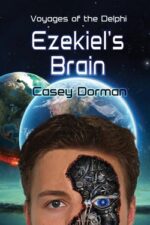
Humans are more vulnerable and wear out sooner than machines. One way to extend intelligent life beyond the limits of our planet’s habitability is to embed that intelligence within machines instead of humans. Long-lived machines, especially ones that can repair themselves indefinitely, could remove the limit on the lifespan of intelligent life. They could explore and colonize other star systems without worrying about how long it took to get there. But can machines be considered life? Do we lose the essence of humanity by replacing ourselves with machines? This is the theme of my Voyages of the Delphi science fiction series, but in that series, humans don’t choose to replace themselves. A superintelligent AI wipes out the human race and replaces it with replicas of itself, who become the main characters in the three books
What would it mean for humans to voluntarily replace themselves with AIs? Can a machine do everything a human can do? We’re seeing already that in the intellectual and problem solving realm the answer is yes, they can. They’re not there yet, but they are approaching that point rapidly. But what about self-consciousness and having emotions? Will AIs be aware? Will they have a sense of identity? Will they be able to feel things? And even if the answers to these questions are yes, will AIs care for each other, as humans do, will they fall in love? Will they feel sympathy, or act with honor? And even if the answers to these questions are yes, will an AI that is aware of itself, and feels the same things humans feel, behave just like humans do? Will it lie, cheat, steal, murder, wage war? Will human-like AIs bring the end of intelligent life on our planet even sooner and more efficiently than humans have been doing?

I’m going to keep thinking about this. My novel, The Gaia Paradox, which is the final novel in the Voyages of the Delphi trilogy, and will be released in July of next year, deals with it a bit, but also focuses on other dilemmas. Whether I tackle this issue in science fiction or in non-fiction essays, I’m not sure, but I am going to do it, because I think it’s important. I will keep all of you posted.
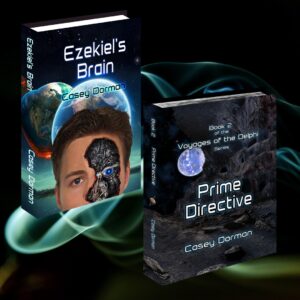
Interested in scif-fi about AIs solving moral dilemmas in a future that has them exploring our galaxy? Read Casey Dorman’s Voyages of the Delphi novels: Ezekiel’s Brain and Prime Directive. Available on Amazon. Click Here!
Subscribe to Casey Dorman’s Newsletter. Click HERE