


Imagining More and Other Stories by Panayotis Cacoyannis
Reviewed by Casey Dorman

I’ve read all of Panayotis Cacoyannis’ novels, but, until now, none of his short stories. These are the first he has published, and in his Afterword, he suggests that he may “end up with short stories.” While I would hate for that to be true, since I enjoy his novels so much, I was not disappointed with this collection of stories. He has a gift for maintaining the reader’s sense of anticipation—his invocation of fear or dread, of the hope for a revelation or solution to a puzzle— that builds within each story, ending with a final divulgement, or a twist into another, unanticipated mystery. The more stories one reads, the more one looks forward to being tantalized by the next. While his novels unravel layer after layer of the mystery that is eluding the character in his own discovery of himself, the short stories raise questions often unanswered, but always entertaining. He is a master of the genre.
Imagining More, the beginning story and the one in the book’s title, was my favorite, perhaps because it tapped one of the author’s favorite themes: the confusion of identity, which we all experience and which his characters exemplify prominently enough for us to detect it in their actions. He helps us by alternatively viewing the interior thoughts of each character as they observe, from their different perspectives the same events. In a bold stroke of originality, we readers are fooled as we are at first taken in by Peter and Kate, the personas that the two real characters, George and Lydia are playing, and we have to re-orient our understanding of the scene when we find they are not real. George and Lydia are simultaneously re-orienting themselves as they shed one role for another. All of this is done in the presence of Marianne, a reporter who is interviewing George and Lydia on their method style of acting. We find ourselves wondering, along with Marianne, whether we are talking to the real George and Lydia or another set of roles they are playing. All of this is accomplished within the context of an edge-of-your seat thriller, as we wait, apprehensively, for the denouement, which turns out to be as enigmatic as the story itself.
The writing, as is characteristic of Cacoyannis, is startlingly vivid, picturesque, often metaphorical, so much so that, my immediate reaction, as a began the first story was that I should present it to my writer’s group as an example of what I mean when I speak about “genuine literary” writing. For example: “Night still lingers on. Not quite night, not quite dark. Even the grey of dawn is prickled by stray dots of brightness, day has not yet broken: that otherworldly tinge of dusty in-betweenness stubbornly refuses to dissolve, as though as a reminder that a blur, nothing more, is what stands between life and drift to a permanent sleep.” Cacoyannis, for me, stands squarely in the midst of my favorite, most poetic modern and recent writers, such as Lawrence Durrell, Isabelle Hammad, William Boyd, or Ian McEwan in terms of literary style, and he is the most profound among them in terms of portraying the interior complexities of his characters.
Several of his stories touch on Kafka and The Metamorphosis, as an idea, an obsession, or as an alter ego, as it was for the character in the first of Cacoyannis’ novels, A Bowl of Fruit. A strong suggestion of this character is in the short story, The Gift, but Kafka also figures prominently in The Rooms, and even surfaces for a moment in Imagine More. Other characters from other novels, or versions of them, appear in other of the stories, most clearly in Mr. Rubens in A Day at the National People’s Museum, which encapsulates some of the theme of The Coldness of Objects, my favorite Cacoyannis novel.
This is a remarkable collection. Not only is each story a rare gem, but Cacoyannis has managed to put his own imprint on a style that permeates each story. Poetry of language, intense inner scrutiny of characters, complex relationships perfused by shadings from each character’s past and present obsessions, and surprising and often enigmatic endings is a style that elevates the entire oeuvre in this book to a work of art.
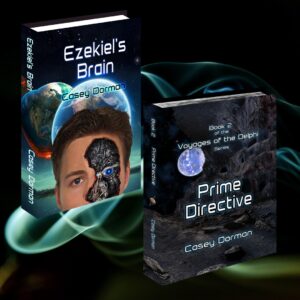
For something completely different, read my scif-fi about conscious AIs solving moral dilemmas in a future that has them exploring our galaxy? Read the Voyages of the Delphi novels: Ezekiel’s Brain and Prime Directive. Available on Amazon.Click Here!
Subscribe to Casey Dorman’s Newsletter. Click HERE