


From Biological to Artificial Consciousness
Masataka Watanabe
(Translated into English by Tony Gonzalez)
Springer Nature Switzerland
2022

This book, part of the Springer Frontiers Collection on issues in science, was originally published in Japanese as Brain Consciousness, Machine Consciousness, in 2017. It’s a remarkable, groundbreaking, and exceptionally well-written book. In a brief, 172 pages, the author, an internationally known neuroscience researcher, provides the most lucid, understandable description I’ve ever read of how the brain and its neurons function, at least regarding visual perception. He also presents a tremendously exciting, breakthrough model of how the brain produces conscious perception. As an added treat, his method of validating his theory involves uploading human consciousness into a machine, something he believes is possible.
Watanabe’s approach, both in how he thinks about consciousness and how he presents it to the reader is methodical, grounded in verifiable fact, and his reasoning is presented in a way that is easy to follow. He begins with a quote from Sir Francis Crick, that, “You are nothing but a pack of neurons.” His point is that our consciousness is produced by our brains, and our brains are made of material stuff. How that material stuff works together as a coordinated entity is not just the key, but the only answer to the question of how consciousness is created.
For the author, the most defining feature of consciousness is that it is the “subjective experience of vision audition, tactile sensation, emotion, decision making, etc. In other words, qualia.” There is a world around us, but if we are alive and awake, we have the sense of being someone who is experiencing it. That sense is our subjective experience, i.e., consciousness. How a brain takes the objective world, consisting of things like light or sound waves, which stimulate our sense organs, which initiate neural firing, which then travels to our brains, further igniting firing across different areas of the brain, and, finally, produces a subjective experience, is “the hard problem,” as David Chalmers called it.
Watanable addresses the hard problem forthrightly and with optimism. He is aware that much of the controversy in consciousness research revolves around how it is defined and he takes the challenge of using science to study it by searching for a “natural law” of consciousness, in the sense of a verifiable law that “cannot be derived from scientific theories,” and is just “how the universe works.” He cites the universal gravitational force and the invariant speed of light as examples. He is looking for such a law for subjective consciousness. Natural laws do not depend on theories (though our human understanding of them may), but they must be verifiable using scientific methods. He examines some candidates such as Chalmers’ idea that consciousness is information, or Penrose and Hameroff’s idea of consciousness being quantum effects in the microtubules that form the cytoskeletons of neurons and finds both wanting in terms of either verifiability or agreement with known facts.
Watanabe examines other current theories and fastens on the Integrated Information Theory of Giulio Tononi. He uses that theory to account for how the visual information is processed in the brain and shows that it is successful, while Chalmers’ theory is not. But he goes further to show that it is the interpretation of integrated information, that coincides with consciousness, and that interpretation requires more than just the information itself, it requires an algorithm to interpret it. That algorithm also must be expressed in the workings of the system in the form of a law that “such and such activities within a system, such as the brain, will result in subjective experiences.” (quotation mine). He goes one step further by saying that the causal relationship between neuron-like actions and subjective experience need not involve real neurons, nor living creatures. He makes the points that, 1) “if there are natural laws of consciousness, they are likely to have existed from the moment of the Big Bang,” and 2) “it is therefore unlikely that they apply only to central nervous systems like those found on Earth.” This opens the door for machine consciousness. Real neurons need not be necessary. Abstract ones will do. This also opens the door for a way to validate a theory of consciousness. Consciousness is something each one of us experiences, but not something we can share with each other. But, even if we can’t share our subjective experiences directly with each other, we can, perhaps, create such experiences by simulating neural activities in a machine and the machine, with its simulated neurons, will (consciously) experience them. If a machine expresses the algorithm that creates consciousness, then we could transfer our own consciousness into that machine. If we are still conscious within the machine, then the model would be deemed correct.
Watanabe’s suggestion is bold, bordering on science fiction. But being a science fiction writer who has written a series featuring conscious AI androids, I was very happy to learn that a world class neuroscientist shares my view. Machines can be conscious. He suggests that, by using an AI as a substitute cerebral hemisphere, and transferring our own consciousness into it, we would demonstrate that a machine that operates by implementing the correct algorithm, can support a subjective consciousness, thus validating his model of consciousness. That model will express the natural law of consciousness by becoming conscious, and the human whose consciousness it supports will be the observer that (subjectively) validates it (but others could also validate it by presenting the machine with whatever challenges would be appropriate for proving that a human is conscious).
Almost as interesting as the fact that the author uses a machine to demonstrate the architecture and working of a neural network that creates consciousness, is that that neural network, as Watanabe envisions it, is very similar to the multi-layer, back-propagation based neural networks that support deep learning in machines and are the backbone of most current AIs. He points out that such networks were originally put forward, first by Shun’ ichi Amari, and later by Rummelhart, Hinton, and Williams, as models that mimicked, albeit in an abstract and simplified way, the workings of the brain. His model is similar to the one proposed by Antti Revonsuo in 1995 in the journal, Philosophical Psychology in that it proposes that subjective reality is a type of virtual reality created by our brains. Fittingly, he also references the science fiction classic, Permutation City, by Greg Egan, and the film, The Matrix when discussing his model. He uses it to account for the findings in Benjamin Libet’s classic experiments on the timing of brain and conscious events, as well as a number of other findings in cognitive science.
As I said, this is a remarkable book. The author is not just a good writer; he is an excellent teacher. His book is a primer in how to apply the scientific method and the reasoning that goes along with it, first to figuring out how the brain works and then to figuring out how it creates consciousness. He may be incorrect about the latter, but at least he presents a way to test the model, although not until we develop more sophisticated machines. For those only slightly familiar with neuroscience or the science of consciousness, this is a good book to read to learn something about it. For those who are already well-versed in these topics, it is refreshingly clear and marvelously creative in its content. It also provides a good reality check on those who “believe in” one or another theory of consciousness because it sounds good to them, or even because the theory makes sense and may be elegant, in terms of its mathematical or theoretical properties. Such characteristics may make a theory appealing, but its adherents usually haven’t thought about how scientists approach such theories, with the requirement that they must make the theory’s predictions both concrete and testable. Watanable does just that in this book. I highly recommend it.
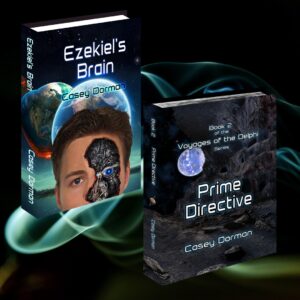
Interested in scif-fi about conscious AIs solving moral dilemmas in a future that has them exploring our galaxy? Read Casey Dorman’s Voyages of the Delphinovels: Ezekiel’s Brain and Prime Directive. Available on Amazon. Click Here!
Subscribe to Casey Dorman’s Newsletter. Click HERE